
For an artist whose work was made to disappear, Ana Mendieta has proven remarkably hard to forget. The Cuban-American artist produced for barely a dozen years before her death in 1985 at the age of thirty-six, yet the silhouettes she pressed into the earth continue to shape how we think about the body, the landscape and belonging. Tate Modern now stages the first in-depth UK survey of her work in more than a decade, reuniting the ephemeral earth-body pieces she called siluetas with newly remastered films, early paintings and late sculptural works, many of which have never been shown in Britain before.

The Silueta Series
Mendieta is best known for the Silueta Series, produced across Mexico and Iowa between 1973 and 1980. Working directly in mud, sand, grass, flowers, fire and water, she traced the outline of her own body into the landscape, then allowed the elements to erase it. Photographs and films are all that remain. The earliest of these, Imágen de Yágul from 1973, shows the artist lying within an excavated niche among the ruins of a Zapotec temple, her form half-buried in white flowers. She always considered it her first silueta, and the exhibition places it at the centre of her practice.
What distinguishes these works from the land art of the same period is their intimacy. Mendieta was not imposing a grand gesture upon nature but merging with it, testing where her body ended and the earth began. The resulting photographs are at once tender and unsettling, records of presence and absence held within a single frame. Fire, water and flowers became her materials as much as soil and stone, each chosen for what it might express about a body that belonged to two continents and, in some sense, to neither.

Returning to the Land
The survey also traces Mendieta's late return to her birthplace. In 1981, back in Cuba for the first time since childhood, she carved a series of figures directly into the soft limestone of the island's caves. She titled them Esculturas Rupestres, or Rupestrian Sculptures, drawing their forms from the Neolithic carvings she encountered there and from Afro-Cuban and indigenous Taíno traditions. Tate Modern has reconstructed several of these works, including the blood-and-earth imprint Ñañigo Burial from 1976, allowing visitors to experience their scale in a way photographs cannot convey.
The curatorial team, led by Valentine Umansky with Michael Wellen and Elsa Collinson, frames Mendieta not as a tragic footnote but as a figure of radical agency. Her work returned again and again to displacement and identity, to what it means to belong to a land from which you have been separated. Those questions, raised by a child sent from Cuba to America at the age of twelve, feel no less urgent today.
A Legacy Reclaimed
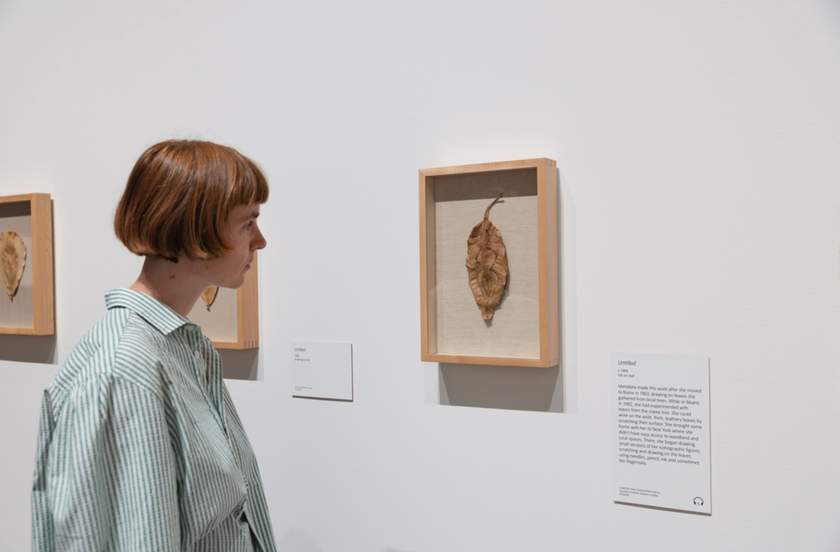
Mendieta described her practice in terms that deliberately undercut the scale and ego of much contemporaneous art. My work is basically in the tradition of a Neolithic art, she said in 1984. I am not interested in the formal qualities of my materials, but their emotional and sensual ones. It is a philosophy this exhibition takes seriously, placing feeling ahead of form and asking visitors to slow down rather than simply look.
Her influence now extends far beyond the gallery. Artists working with the body, with landscape and with acts of ritual recovery routinely cite Mendieta as a touchstone, and her insistence that a fleeting gesture could carry permanent weight has shaped a generation. The exhibition gathers early paintings alongside the films and sculptures, making the case that her achievement was broader and more deliberate than the mythology around her death has sometimes allowed.

The show runs at Tate Modern until 17 January 2027 and is likely to be remembered as one of the year's essential exhibitions. For a generation that knows Mendieta chiefly through photographs reproduced online, this is a rare chance to encounter the physical presence of her work, and to understand why her fleeting gestures have proved so enduring. The body disappears, but the mark remains.