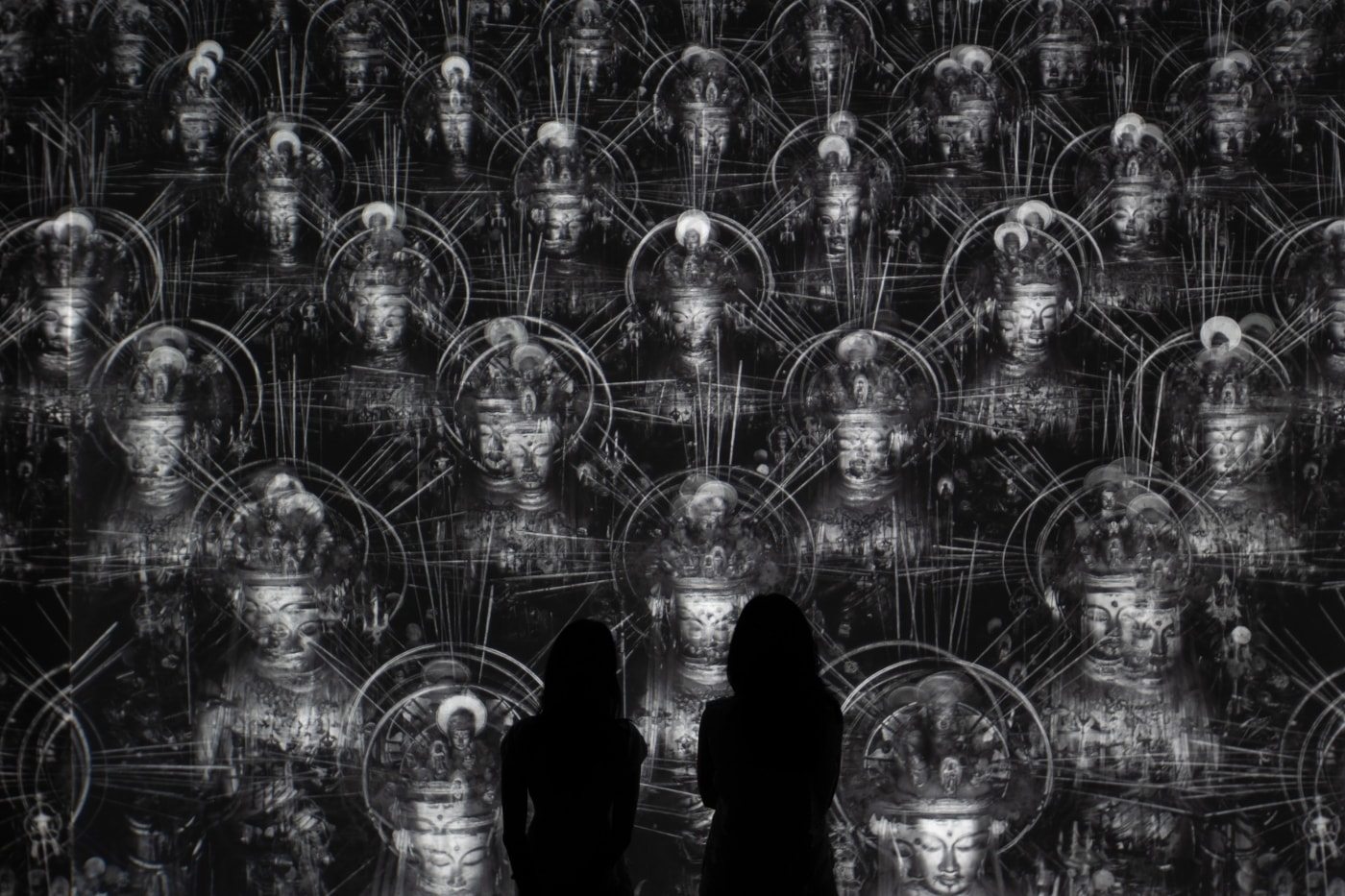
Hiroshi Sugimoto, one of the most internationally celebrated artists working today, has arrived in Southeast Asia with a comprehensive survey that redefines how his work is experienced. Form Is Emptiness, now open at Singapore Art Museum at Tanjong Pagar Distripark through October 4, brings together over 60 works across 11 series alongside 14 fossil specimens from the artist's personal collection, creating a dialogue between deep time and contemporary perception that only Sugimoto could orchestrate.
Born in Tokyo in 1948, Sugimoto has spent five decades exploring the intersections of time, consciousness, and the nature of seeing. This exhibition, his first major survey in Southeast Asia, draws its conceptual core from the Heart Sutra and its central proposition that form is emptiness, that what appears tangible is contingent rather than permanent. Sugimoto designed the exhibition space itself as a mandala, the geometric representation of the universe in Buddhist and Hindu traditions, guiding visitors through interconnected paths that mirror cyclical rhythms of nature and life.
Several of Sugimoto's most iconic series anchor the show. Seascapes, an ongoing project since 1980, distills the world into an elemental balance of sea and sky through perfectly centered horizon lines. The Theaters series uses long-exposure photography to compress the duration of an entire film into a single luminous frame, drawing a parallel between the lifespan of a film and human existence. The Opticks series revisits Isaac Newton's experiments, dissolving form into immersive fields of colour and interrogating the basis of visual perception.
New work makes its debut here as well. Spacescape (2024), a folding screen depicting the Earth and Moon in orbit, was developed in collaboration with JAXA, the University of Tokyo, and Sony. Brush Impression, Heart Sutra (2023), a monumental installation of 288 gelatine silver prints created by writing the sutra on photographic paper with fixer in near-darkness, translates sacred text into luminous abstraction. These are complemented by Sugimoto's first video work, Accelerated Buddha (1997-2017), and a selection of fossil specimens he considers pre-photography time-recording devices.
For a region where Buddhist philosophy resonates deeply, the choice of Singapore as the venue for this survey carries particular weight. The exhibition does not simply present Sugimoto's work, it constructs an environment where the work's philosophical underpinnings become palpable. Visitors move through spaces designed to heighten awareness of absence as much as presence, of the conditions that shape perception rather than the objects perceived. It is an experience that rewards slow attention.