
Set among wild grasslands and densely wooded slopes in Georgia's northeastern province of Kakheti, the Kvareli Foundation for Contemporary Art has opened its doors as the country's most ambitious new cultural destination. The centre overlooks vineyards on an estate some 130 kilometres from the capital, Tbilisi, in a region traditionally known for wine production rather than contemporary art. Its founder, Georgian businessman Jemal Inaishvili, was inspired by a visit to Naoshima Island on Japan's Seto Inland Sea, that country's famed privately funded arts hub, and decided to build something comparable at home, anchored by a selection from his personal collection of some 1,500 pieces of largely Georgian art.
A building that behaves like a monument
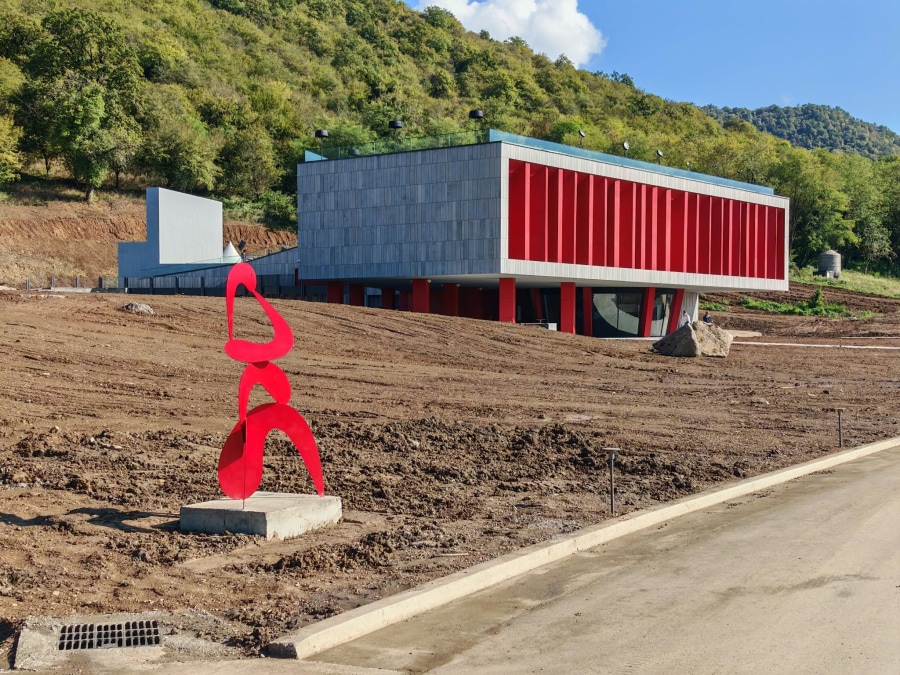
Inaishvili enlisted Tbilisi-based architecture practice Midamo, led by Giorgi Chkonia and Dato Danelia, to create the selected design concept. The scheme was further developed by the foundation's in-house designer and architect Irakli Sharpilo. The building itself had to be like a contemporary art monument, Inaishvili says, and that was very important for the project. An elongated concrete box defined by the dense repetition of red-tiled vertical fins and framed within grey textured panels, the new art institution balances rugged industrial materials with the region's verdant landscape. The vivid red of the fins echoes traditional Georgian craft while creating a powerful visual dialogue with the surrounding green hillsides.
From landscape into art
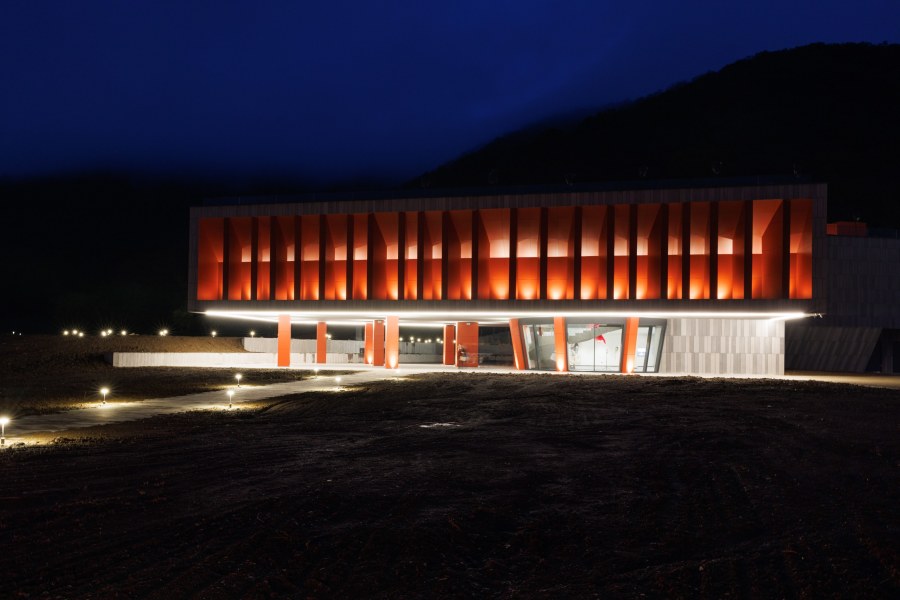
Spanning more than 23,680 square feet, the art centre acts as a bridge between the contrasting backdrop of vertical mountains and the stretch of flat, horizontal vineyards, according to Chkonia. Beneath the elevated mass that forms the gallery space, a deep recess gives way to an entrance paved in a weave of basalt tiles. Beyond lies a wood-decked garden courtyard alongside a rock-strewn pond. The intention was for visitors to experience a seamless journey from nature into art, Chkonia explains. You approach from the landscape, walk up a curved staircase, and discover the galleries as you move through the building. This sudden shift in space creates a powerful sense of surprise.
Inside the galleries
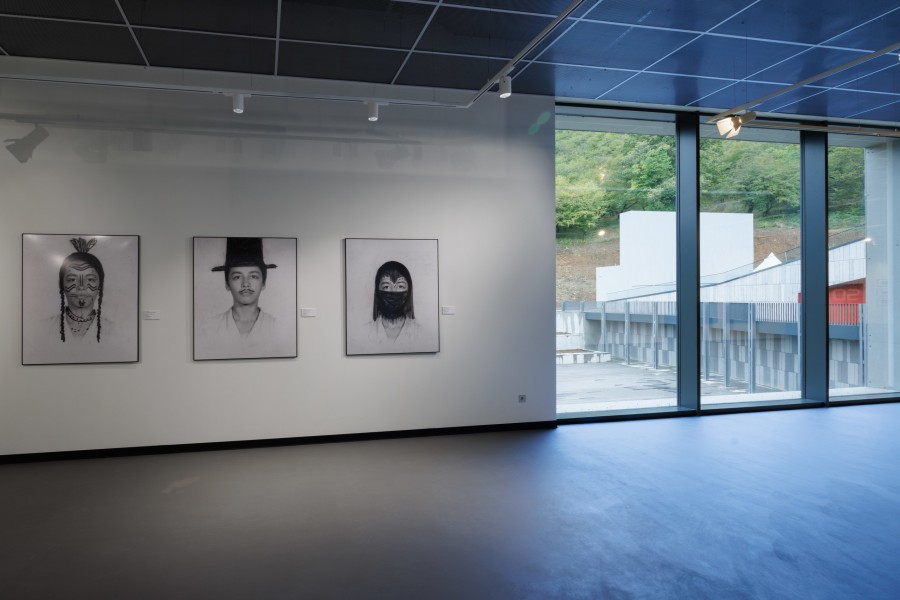
The space delineates areas through a range of ceiling treatments, with a classic white-cube gallery on the ground floor giving way to the embrace of exposed, raw, structural elements on the level above. An industrial approach to the fifth wall, with fixtures and cables on display, runs throughout the entire first floor. The inaugural exhibition, Georgian Contemporary Art: Origins and Continuities, traces the genre's evolution from the 1960s to the present, including the divergence and eventual departure from Soviet ideological narratives and the exploration of new forms of expression in the post-Soviet era. Three large black-and-white portraits hang in a neat row in the ground-floor gallery, their subjects gazing out through the floor-to-ceiling glazing towards the forested hills beyond.

An amphitheatre in the sky
The foundation brings together exhibition spaces over three floors, including an outdoor amphitheatre with wide, shallow steps ascending to a sweeping rooftop with panoramic views of the Caucasus foothills. The art foundation sits at the heart of a wider cultural complex that includes a winery and a 94-room boutique hotel scheduled to open by the end of 2026. Inaishvili says he hopes the institute, conceived as a multifunctional space to support a public programme of exhibitions, talks, performances, film and music events, presents an inviting proposition in the region. People come for wine, for good food, he says, but they should also come for something different.

What comes next
Creative director Nino Sulkhanishvili says the foundation will play a role in supporting the development of contemporary artistic practice, which she says currently lacks adequate representation in the country. Through exhibitions, research and public programmes, it will provide a space for artists to develop their practice, strengthening regional production. It will also serve as a platform for education, critical discourse and international exchange. Upcoming exhibitions will build on the foundations of the inaugural show, expanding into new media and international collaborations. For a country where contemporary art infrastructure remains in its infancy, the Kvareli Foundation represents a significant bet on culture as a catalyst for the Kakheti region's future.