
Fisherman's Village in Koh Samui has always been a place of contradictions. The fishing boats still come in at dawn, the street food stalls still line the main drag, and the night market still draws crowds who come for grilled seafood and cold Chang. But in recent years, the village has also become something else: a place where the old Koh Samui and the new Koh Samui share the same postcode without apology. LUNA Gastro Theatre sits at the exact intersection of those two versions of the island, and it does so with the kind of confidence that only comes from knowing exactly what you are.
LUNA is not a restaurant that happens to have live music. It is not a fine dining establishment that added a bar as an afterthought. It is a three-level culinary theatre where every element, from the open kitchen on the ground floor to the panoramic bar on the second floor to the open terrace that catches the last light over the Gulf of Thailand, was designed to serve a single purpose: to make the meal a narrative, not a checklist.
Designed as a complete 360-degree immersive experience uniting cuisine, wine, lighting, and sound, backed by rigorous service standards aiming for Michelin-level distinction.
LUNA Gastro Theatre

The Kitchen as Stage
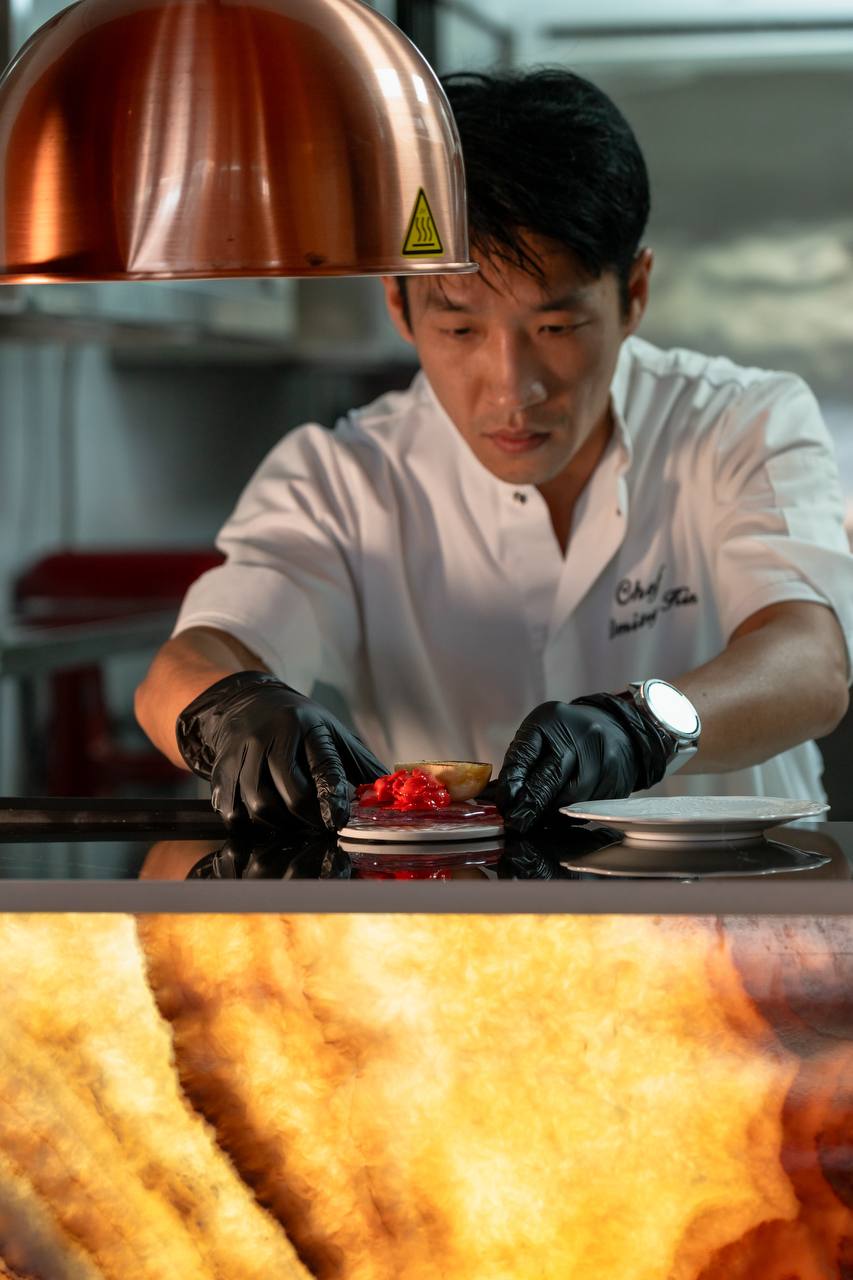
At the centre of LUNA's ground floor is an open kitchen that functions less like a production line and more like a stage. Head Chef Dmitry Kim operates in full view of the dining room, and the arrangement is deliberate. Every dish is personally created by Chef Dmitry Kim, balancing creativity, precision, and unforgettable flavours, with a 10-course tasting menu that interprets Thailand's flavours and tropical character through coconut variations, refined seafood techniques, and local produce. Alongside the signature set menu, LUNA also offers a main à la carte menu where guests can order individual dishes, making the experience accessible without compromising on quality. The kitchen is visible, audible, and present. You hear the sear, you see the plating, you understand that what arrives at your table has been made by a specific person with a specific philosophy, not assembled from a prep list by a brigade following a manual.


Chef Dmitry's journey to Koh Samui is its own narrative. A virtuoso whose craft is as much about imagination as technique, he brings a palate fine-tuned to precision and a flair for the dramatic that turns each course into a scene rather than a serving. The menu embraces the bountiful resources of Koh Samui: local seafood, tropical fruits, herbs from the island's gardens, and coconuts that appear in multiple courses in forms that make you rethink what a coconut can be. Kamchatka crab with orange pearls. Homemade green aioli from wild garlic. Dishes that nod to tradition but leap towards innovation, a signature blend that has become synonymous with LUNA.


Ten Courses, One Story
The signature tasting menu at LUNA is not a collection of dishes. It is a sequence. Each course leads to the next with the kind of intentionality that only comes from a chef who has thought about the entire journey, not just the individual plates. Every course is part of one unforgettable culinary journey, carefully curated so that each dish naturally leads to the next, creating a harmonious tasting experience from beginning to end. Coconut appears in its most literal form and then again as a foam, a gel, a crisp. Seafood moves from raw to cured to seared, each preparation building on the last. The pacing is theatrical not in the sense of spectacle but in the sense of structure: beginning, development, climax, resolution.
The ingredients are local and sustainable, sourced from trusted fishermen, farmers, and artisan producers on the island. This is not a restaurant that flies in truffles from Alba and calls itself farm-to-table. The supply chain is genuinely short. The fish comes from the pier a few kilometres away. The herbs come from the garden. The result is a menu that could only exist here, on this island, at this moment in the season.


The Symphony of Live Music
What separates LUNA from every other tasting menu restaurant on Koh Samui, and arguably in Southeast Asia, is the integration of live music into the dining experience. Live performances by talented local Thai artists weave an extra layer of storytelling, intimacy, and sound into the dining journey, transforming each meal from a sequence of courses into a multi-sensory narrative. The musicians are not background entertainment. They are part of the architecture. A saxophone line that enters between the fifth and sixth course. A vocal that rises as the fish course arrives. The sound and the food are timed to complement each other, not compete.
The musicians are Thai, and their repertoire reflects it. Traditional instruments and contemporary arrangements sit side by side, creating a soundscape that is rooted in place without being parochial. The effect is cumulative. By the third course, you stop noticing the music as a separate element and start experiencing it as part of the meal, the way wine functions in a pairing: present, enhancing, but never dominant.
Three Levels, Three Rhythms
LUNA occupies three distinct levels, and each one has its own rhythm. Three distinct levels reinterpret Fisherman's Village energy: the ground-floor open kitchen and live music stage, the second-floor panoramic bar with curated cocktails and ocean views, and the open terrace overlooking the sea, mountains, and sunset. The ground floor is where the action is: the open kitchen, the live music, the energy of a room where people are eating and listening and watching. The second floor is the panoramic bar, where the cocktails are as considered as the food and the views stretch across the Gulf. The open terrace is where the evening ends, with the sea on one side, the mountains on the other, and the kind of sunset that makes you understand why people build restaurants facing west in the first place.
The transition between levels is not just vertical. It is temporal. You arrive on the ground floor with an appetite. You move to the bar between courses, or after the meal, with a cocktail and a view. You end on the terrace with the last light and the kind of quiet that only comes after a meal that has given you everything it promised. Each floor is a chapter. The building is the book.
The LUNA Invitation
LUNA describes itself as an invitation to experience Thailand through gastronomy, art, music, and atmosphere. It is a statement that could easily be marketing copy at any other restaurant, but here it functions as a kind of mission statement that the kitchen and the music programme and the architecture all actually deliver on. LUNA's soul is an invitation to experience Thailand through gastronomy, art, music, and atmosphere, now recognised among the top 10% of restaurants worldwide on Tripadvisor. The Tripadvisor ranking, which places LUNA in the top 10 per cent of restaurants globally, is not the kind of metric that usually defines a place like this, but it does confirm what the room already tells you: this is not a hidden gem waiting to be discovered. It is a fully realised vision that happens to be in Fisherman's Village, Koh Samui, and it is worth the journey.
Chef Dmitry Kim's kitchen is an open stage. The musicians are local artists who carry the island's sound. The terrace catches the sunset. And the 10 courses, taken as a whole, tell a story that could only be told here, with these ingredients, at this latitude. LUNA is not a restaurant you visit. It is a performance you attend.